
ORGİNAL ARTİCLES VOLUME: 1 ISSUE: 1 P: 1-8#1-8 March 2026
Clinical Spectrum and Antimicrobial Resistance of Neonatal Staphylococcus aureus Sepsis: A Seven Year Case-Control Study
Cehad Journal • 2026
DOI: 10.5578/ced.20260115
Received: 06.05.2025 Accepted: 24.09.2025 Publish: 17.03.2026

ABSTRACT

Objective

Staphylococcus aureus bloodstream infections are a notable cause of neonatal morbidity and mortality. Limited data exist regarding the clinical spectrum and resistance profiles of neonatal S. aureus sepsis, particularly in early-onset cases and those caused by methicillin-resistant strains. In this study, we aimed to evaluate the clinical characteristics, antimicrobial resistance patterns, and outcomes of culture-proven neonatal S. aureus sepsis.

Materials and Methods

We conducted a retrospective, single-center, case-control study in a tertiary neonatal intensive care unit, including neonates diagnosed with S. aureus sepsis between 1 January 2018 and 31 December 2024. Fifty-three neonates with culture-proven S. aureus sepsis were compared to 106 matched controls without any documented bloodstream infection (no growth in blood cultures). Demographic characteristics, clinical features, antimicrobial resistance patterns, and outcomes were analyzed. Subgroup comparisons were performed for methicillin-resistant S. aureus (MRSA) vs. methicillin-susceptible S. aureus (MSSA) and early-onset sepsis (EOS) vs. late-onset sepsis.

Results

Among the 53 S. aureus sepsis cases, 50.9% were classified as EOS and 62.3% were due to MRSA. Community-acquired infections accounted for 90.6% of the cases, with MRSA responsible for the majority. Cutaneous manifestations were noted in 26.4% of the neonates. MRSA-infected infants had significantly longer durations of total parenteral nutrition compared to MSSA cases (p= 0.048). All isolates were susceptible to vancomycin and linezolid; 26.4% showed resistance to clindamycin and tetracycline. Septic shock developed in 49.1% of the cases, and one infection-related deaths occurred (1.8%). An increasing trend in MRSA prevalence was observed over the study period.

Conclusion

Neonatal S. aureus sepsis, particularly due to MRSA, remains a serious clinical concern with considerable morbidity. The predominance of community-acquired infections and rising resistance highlight the need for vigilant surveillance and optimized empirical treatment strategies, especially in early-onset cases.


KEYWORDS

Neonatal, sepsis, antimicrobial resistance, MRSA, healthcare-associated infections


INTRODUCTION

Staphylococcus aureus is among the leading gram-positive pathogens responsible for neonatal infections (1-5). In recent decades, methicillin-resistant S. aureus (MRSA) infections have shown a rising trend globally, particularly in developing countries, posing a growing challenge for neonatal care (6- 8). While MRSA has historically been associated with hospital settings, recent epidemiological shifts have revealed a concerning increase in community-acquired MRSA infections (2,5-8). Neonates are particularly vulnerable to S. aureus infections due to immature skin and mucosal barriers, as well as the frequent exposure to invasive medical interventions. While skin and soft tissue infections are frequent presentations of S. aureus in neonates, invasive conditions such as bacteremia, pneumonia, osteomyelitis, myositis, empyema, meningitis, and septic shock have been reported, often associated with significant complications (9-11). Bloodstream infections (BSIs) remain a leading cause of morbidity and mortality in neonates worldwide (1-4). These infections not only result in prolonged hospitalization and increased healthcare costs but also contribute to significant short- and long-term complications, particularly among vulnerable newborns. S. aureus is among the most frequently isolated pathogens in neonatal BSIs and is implicated in both healthcare-associated infections (HAIs) and community-acquired infections (CAIs) (3, 10,11). Neonatal sepsis has been widely studied; however, data regarding the clinical spectrum, microbiologic features, and outcomes of S. aureus BSIs in neonates remain limited. Identifying the causative pathogen in this population is particularly challenging due to the nonspecific clinical presentation and the low yield of blood cultures. Consequently, studies based on culture-proven infections are of great clinical and epidemiological relevance. Therefore, this study aimed to evaluate the demographic and clinical characteristics, antimicrobial resistance patterns, and treatment outcomes of neonates diagnosed with S. aureus sepsis.


MATERIALS AND METHODS

Cengiz Gökçek Women’s and Children’s Hospital is a tertiary public hospital specializing in obstetrics, gynecology, and pediatrics. It serves as a regional referral center in southeastern Türkiye, with approximately 10.000 deliveries per year and 650 annual admissions to its 80-bed neonatal intensive care units, including a 45-bed tertiary unit. Study Design and Population We conducted a retrospective study of newborns diagnosed with S. aureus BSIs in the neonatal intensive care unit (NICU) of Cengiz Gökçek Women’s and Children’s Hospital Hospital, Gaziantep, Türkiye, between 1 January 2018 and 31 December 2024. Infants with culture-proven S. aureus sepsis were identified through routinely collected electronic health records. Demographic data-including gestational age, birth weight, sex, and clinical outcomes-were extracted. Clinical parameters such as presenting symptoms, associated complications, duration of invasive line use, antibiotic regimens, and treatment durations were also collected. Antibiotic susceptibility profiles and resistance patterns of S. aureus isolates were documented. Each case was classified as either CAI or HAI. Microbiological data were retrieved from the hospital’s electronic database. If multiple cultures tested positive for S. aureus during hospitalization, only the first isolate was included to avoid duplication. Neonates who met the clinical criteria for sepsis, had a positive blood culture for S. aureus, and received ongoing treatment in the NICU were included. Patients who were transferred to another facility or had incomplete or unavailable medical records were excluded. This study was approved by the Gaziantep University Ethics Committee (Approval no: 2025/63). Definitions Neonatal sepsis was defined as a clinical syndrome characterized by systemic signs of infection occurring within the first 30 days of life (12). Based on the timing of onset, cases were classified as either early-onset sepsis (EOS), defined as sepsis occurring within the first 72 hours of life, or late-onset sepsis (LOS), defined as sepsis occurring between day 4 and day 30 of life (12). An infection was considered communityacquired if the organism was detected within 48 hours of admission, during outpatient care, or later than 48 hours if symptoms were already present at the time of admission. Hospital-acquired infections are infections that occur 48 hours or more after hospital admission, were not present or incubating at the time of admission (13-15). Control neonates, free from infection, were chosen from the same NICU as the case patients. Their selection involved matching by admission period (initially within a ±30-day window, extendable by an additional ±30 days if fewer than two controls were available), absence of S. aureus growth from sterile sites, and concordance in gestational week and birth weight. The aim was to secure a minimum of two controls per case. Microbiological analysis S. aureus isolates were identified using standard microbiological methods and confirmed by matrix-assisted laser desorption ionization time-of-flight mass spectrometry (MALDI-TOF MS). Antimicrobial susceptibility testing was performed using the VITEK® 2 system (bioMérieux, Marcyl’Étoile, France). Methicillin resistance was determined based on oxacillin and cefoxitin susceptibility, and isolates were classified as MRSA or MSSA accordingly. Susceptibility to antibiotics including clindamycin, erythromycin, gentamicin, trimethoprim-sulfamethoxazole, rifampicin, vancomycin, linezolid, and teicoplanin was interpreted in accordance with Clinical and Laboratory Standards Institute guidelines. Statistics Statistical analyses were conducted using SPSS software, version 23.0 (SPSS Inc., Chicago, IL, USA). Descriptive statistics were used to summarize the baseline characteristics of the study population. Means with minimum-maximum values or medians with interquartile ranges (IQRs) were reported for continuous variables, while frequencies and percentages were provided for categorical variables. Categorical variables were compared using the chi-square test or Fisher’s exact test, as appropriate. The distribution of continuous variables was assessed using the Kolmogorov-Smirnov test. For group comparisons, the independent samples t-test was used for normally distributed data, whereas the Mann-Whitney U test or Kruskal-Wallis test was applied for non-normally distributed data. To estimate the strength of associations, odds ratios (ORs) with 95% confidence intervals (CIs) were calculated for both dichotomized continuous and categorical variables. In addition, univariate and multivariate logistic regression analyses were performed to identify independent risk factors. A two-tailed p-value of <0.05 was considered statistically significant. Multivariate logistic regression analyses were performed to identify factors associated with MRSA versus MSSA infection, as well as to compare neonates with S. aureus sepsis and uninfected controls.


RESULTS

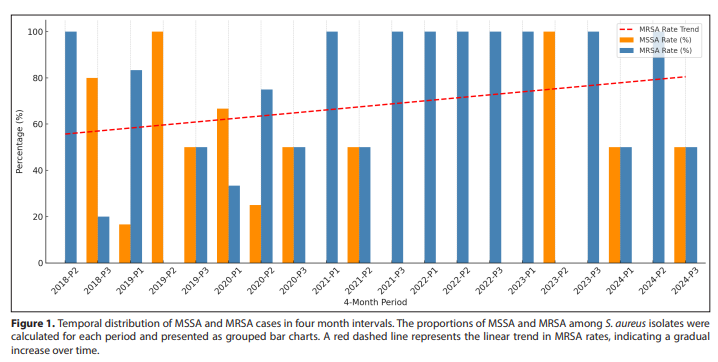
A total of 53 neonates with S. aureus sepsis and 106 matched uninfected controls (matched at a 1:2 ratio) were included in the final analysis, resulting in a study cohort of 159 infants. As presented in Table 1, demographic characteristics were comparable between the two groups. During the sevenyear study period, 53 neonates were diagnosed with S. aureus BSI. Given the approximately 10.000 live births per year at our center, this corresponds to an estimated annual incidence of 0.76 S. aureus sepsis cases per 1.000 live births. Mean gestational age was 38 weeks (min-max; 34-41) in the S. aureus group. A total of 86.8% (46/53) of S. aureus sepsis episodes occurred in term infants (≥37 weeks’ gestation), with the majority of cases seen in those born early term (37- 38+6 weeks), accounting for 50.9% (27/53). In the S. aureus group, comorbidities were identified in 13 (24.5%) neonates. These were including congenital heart disease (n= 4; one with prior valvuloplasty), Rh incompatibility requiring exchange transfusion (n= 3), cephalhematoma (n= 1), operated anal atresia (n= 1), duodenal atresia (n= 1), complicated delivery with clavicular fracture (n= 1), and neonatal seizures (n= 2). Compared to the controls, the neonates with S. aureus sepsis had a significantly longer length of hospital stay prior to infection (OR: 12.09, 95% CI: 2.54-57.5; p= 0.0002) (Table 2). The need for mechanical ventilation was lower in the SA group. Cutaneous manifestations indicative of impaired skin integrity were identified in 14 (26.4%) neonates within the S. aureus sepsis group. These included cellulitis (n= 6), bullous lesions (n= 2), pustular eruptions (n= 3), and omphalitis (n= 2). One case exhibited localized infection at a thoracic tube insertion site. Staphylococcal scalded skin syndrome was diagnosed in two infants. Additionally, concomitant pneumonia was observed in three cases. Vegetation was not detected on echocardiography in any of the patients. No abscess formation was observed on transfontanelle or abdominal ultrasonography. Based on the timing of symptom onset, 50.9% (n= 27) of S. aureus cases were classified as EOS, and 49.1% (n= 26) as LOS. Vaginal delivery was more common in both EOS (55.6%, n= 15) and LOS (61.5%, n= 16) groups, compared to cesarean section (44.4%, n= 12 and 38.5%, n= 10, respectively). While term birth predominated in both groups, preterm birth occurred more frequently among neonates with EOS compared to those with LOS (18.5% vs. 7.6%, respectively) (p= 0.63); all preterm births were classified as late preterm (34- 36+6 weeks of gestation). Median gestational age at birth was 38 weeks in both groups (p= 0.499). Median birth weight was 3000 grams (IQR: 550) in the EOS group and 3100 grams (IQR: 500) in the LOS group (p= 0.799). The median age at onset of LOS was seven days (range: 3-19; IQR: 9). Median length of hospital stay was significantly longer in the LOS group compared to the EOS group [15 days (IQR: 10) vs. 10 days (IQR: 4); p= 0.004]. Antibiotic treatment duration was also significantly prolonged in LOS cases, with a mean of 14 days (min-max: 7-28) versus nine days (min-max: 7-21) in the EOS group (p= 0.018). Among the infants with S. aureus sepsis, 62.3% (n= 33) were infected with MRSA, while 37.7% (n= 20) had MSSA (Table 3). When classified by acquisition setting, 96% (n= 48) of the cases were CA, whereas 9.4% (n= 5) were HA; notably, all HAIs were due to MRSA. Of the CA S. aureus cases, more than half (58.3%) were caused by MRSA. Maternal and neonatal colonization was detected in 3.7% (n= 2) of the neonates. MRSA was isolated from maternal nasal swabs, while MRSA was detected in tracheal aspirate cultures of the corresponding neonates. In two neonates with bullous skin lesions, MSSA was isolated from both blood cultures and the fluid aspirated from the bullae. Septic shock requiring inotropic support was present in 49.1% (n= 26) of the neonates with S. aureus sepsis, with a higher frequency among MRSA cases compared to MSSA, but it was not statistically significant (54.5% vs. 40.0%, p= 0.22). Mechanical ventilation was administered to 14 neonates, and 15.1% required endotracheal intubation (Table 3). An umbilical venous catheter was present in 43 neonates (81.1%). This included 15 (75%) in the MSSA group and 28 (84%) in the MRSA group (p= 0.37). A total of 43.5% of the patients (24/53) required total parenteral nutrition (TPN). Of these, 5 (25%) were in the MSSA group and 19 (57.6%) were in the MRSA group. The difference between the groups was statistically significant (p= 0.021). The mean duration of TPN was significantly longer in the MRSA group (6.7 days; min-max: 0-23) than in the MSSA group (3.15 days; min-max: 0-14) (p= 0.048). A multivariate logistic regression analysis was performed to identify factors associated with MSSA versus MRSA infection, incorporating variables such as septic shock, mechanical ventilation, umbilical venous catheterization, and TPN use. None of these variables were independently associated with the type of S. aureus infection. A similar analysis comparing neonates with S. aureus sepsis and uninfected controls was also conducted, which likewise did not reveal any statistically significant associations. Among 53 S. aureus isolates tested, all were fully susceptible to vancomycin, linezolid, and gentamicin (Table 4). Teicoplanin susceptibility was 90.6%, with resistance detected in five isolates. Fluoroquinolone susceptibility (ciprofloxacin/ levofloxacin) was 60.4%, with 18 isolates showing intermediate susceptibility and three classified as resistant. Resistance to tetracycline and clindamycin was observed in 14 isolates each, corresponding to a susceptibility rate of 73.6% for both agents. Only five isolates were susceptible to benzylpenicillin. Temporal distribution of S. aureus cases was evaluated in four-month intervals (Figure 1). The highest number of isolates was recorded in early 2019, followed by a fluctuating pattern with an overall decreasing trend toward 2024. MSSA was more frequently identified across most periods, whereas MRSA showed greater variability. A gradual increase in the proportion of MRSA among S. aureus isolates was observed over time. Overall mortality in the S. aureus sepsis group was 3.7% (2/53). One of the deceased neonates had hypoplastic left heart syndrome with hemodynamic instability, while the other was a 34-week gestational age infant with EOS and documented S. aureus colonization in both the mother and the infant. The latter died due to septic shock on the fourth day of hospitalization. Infection-related mortality was 1.8%.


DISCUSSION

S. aureus is recognized as a notable cause of invasive bacterial infections in neonates, particularly among those receiving care in NICUs (16-18). While its association with neonatal morbidity and mortality has been acknowledged, data regarding the clinical spectrum, antimicrobial resistance patterns, and risk factors for invasive disease—particularly in relation to methicillin-resistant (MRSA) and methicillinsusceptible (MSSA) strains—remain limited in our settings (5,19). Through this retrospective case-control study, we sought to contribute to the existing body of knowledge by examining the demographic and clinical characteristics, resistance profiles, and outcomes of neonates with cultureconfirmed S. aureus sepsis. Over recent decades, MRSA infections have become increasingly prevalent globally, with resistance rates in neonatal cases exceeding 50% in many Asian countries. Colonization rates among the neonates in Asian settings have been reported between 3.9% and 8.4%, and approximately one in four colonized infants may develop invasive MRSA infection (5). In contrast, European surveillance data show significantly lower rates; for example, a NICU-based cohort study in Germany reported a 0.7% MRSA detection rate and a 0.1% BSI rate among neonates born at <29 weeks of gestation, with a 6.3% associated mortality (20). A meta-analysis from low- and middle-income countries estimated neonatal MRSA colonization at approximately 2.1%, although some African countries reported rates as high as 22.5%, reflecting substantial regional variation (21). In a recent multicenter point-prevalence study involving 31 NICUs across Türkiye, S. aureus accounted for 18.9% of central line-associated BSIs (CLABSIs), with comparable proportions of MRSA and MSSA strains (8.1% and 10.8%, respectively), highlighting its persistent role in neonatal HAIs (22). This recent study from Türkiye did not include the southeastern region. In this context, the incidence rate of 0.76 S. aureus sepsis cases per 1.000 live births observed in our study provides a valuable contribution to the literature. This study highlights the clinical burden of S. aureus sepsis in neonates, with a particular emphasis on term and early term infants. Notably, over half of the infections were classified as EOS, which contrasts with the prevailing literature that predominantly associates S. aureus with LOS (17,19,23). The predominance of term infants, along with the high rate of CAIs, suggests that vertical or early postnatal transmission may be more significant than previously reported (3,17). A particularly concerning finding in our cohort was the high proportion of community-associated MRSA (CA-MRSA) infections, accounting for 58.3% of MRSA cases. This finding reflects a shifting epidemiological trend that has been increasingly recognized worldwide. Traditionally, MRSA was regarded primarily as a healthcare-associated pathogen, but over the past two decades, CA-MRSA has emerged as a prominent cause of invasive infections in neonates, including those without typical hospital-associated risk factors. Studies from various geographic regions have reported a growing burden of CA-MRSA among otherwise healthy neonates presenting with skin and soft tissue infections, bacteremia, pneumonia, and even osteoarticular involvement. For instance, Fortunov et al. observed that over two-thirds of S. aureus isolates in term and late preterm neonates with community-onset infections were methicillin-resistant, with a substantial proportion presenting within the first month of life (3). Similarly, recent surveillance studies in both high- and middle-income countries have demonstrated a steady rise in CA-MRSA prevalence, attributed to widespread community colonization and limited infection control outside healthcare settings (10,11,21,24). Importantly, these data underscore the necessity of considering empiric MRSA coverage, particularly in regions with known CA-MRSA circulation. The higher rates of septic shock and prolonged TPN use in MRSA cases, as well as the statistically significant difference in TPN duration between MRSA and MSSA groups, align with findings from Wu X et al., who also reported greater severity and nutritional impact in MRSA-infected neonates (5). These observations may indicate a more virulent clinical course for MRSA sepsis, necessitating early recognition and aggressive supportive care. Strikingly, skin manifestations were common among our cases, highlighting the skin as a potential early window into systemic S. aureus infection. In neonates, where clinical signs of sepsis may be subtle or nonspecific, the presence of characteristic cutaneous lesions can serve as a valuable diagnostic clue, prompting early suspicion and targeted antimicrobial therapy. This observation aligns with previous reports underscoring the importance of skin and soft tissue involvement in the clinical spectrum of neonatal S. aureus disease (17,19,25). Empiric antibiotic strategies for neonatal sepsis should ideally be aligned with local resistance patterns and organism prevalence. In our cohort, ampicillin-gentamicin was predominantly used for EOS, while vancomycin-gentamicin was common in LOS. However, all S. aureus isolates in this study demonstrated full resistance to penicillin, and a significant proportion were MRSA. These findings raise concerns regarding the adequacy of ampicillin-based empiric coverage, particularly in settings with high MRSA prevalence. Consistent with international recommendations, including those by McMullan et al. and Shadbolt et al., our data support the early inclusion of vancomycin in empiric therapy for neonates at risk for MRSA, especially in LOS or when clinical signs suggest skin and soft tissue involvement (4,17). Moreover, the high susceptibility rates to gentamicin and linezolid suggest these agents remain effective options, but teicoplanin resistance observed in nearly 10% of isolates warrants cautious use. Recent studies emphasize the growing global burden of MRSA in NICUs, particularly in preterm and low birth weight infants (19). In this context, traditional empiric regimens such as ampicillin and gentamicin may offer inadequate coverage in areas with high MRSA prevalence. Studies have underscored the necessity of early vancomycin use in empirical treatment, particularly in high-prevalence MRSA settings (26,27). Furthermore, MSSA remains a critical pathogen that can lead to significant morbidity, comparable to MRSA, and should not be overlooked in surveillance or prevention efforts. This study has several limitations. First, its retrospective design may have introduced bias related to incomplete documentation and inter-clinician variability in diagnostic and therapeutic approaches. Second, molecular characterization of S. aureus isolates-such as virulence factor profiling or strain typing-was not performed, limiting our understanding of potential pathogen-related differences in clinical presentation or outcomes between MRSA and MSSA cases. Third, the absence of detailed maternal data, including information on bacterial colonization, infectious disease history, and obstetric risk factors, precluded assessment of perinatal influences on neonatal infection risk, particularly in early-onset cases. In conclusion, this study contributes to the limited data on neonatal S. aureus sepsis by characterizing its clinical features, antimicrobial resistance patterns, and outcomes in our tertiary care setting. The predominance of MRSA, the high proportion of early-onset cases, and the considerable burden of CAIs suggest evolving epidemiological dynamics and the need to strengthen perinatal infection prevention strategies. The observed resistance profile raises concerns about the adequacy of standard empiric regimens, emphasizing the importance of context-specific antibiotic approaches. Despite its retrospective design, our findings highlight the critical role of surveillance, maternal risk assessment, and early recognition in improving outcomes in this vulnerable population.

CONCLUSION

-


REFERENCES

1
Shane AL, Sánchez PJ, Stoll BJ. Neonatal sepsis. Lancet 2017;390(10104):1770-80. https://doi.org/10.1016/S0140- 6736(17)31002-4
2
Shane AL, Sánchez PJ, Stoll BJ. Neonatal sepsis. Lancet 2017;390(10104):1770-80. https://doi.org/10.1016/S0140- 6736(17)31002-4
3
Fortunov RM, Hulten KG, Hammerman WA, Mason EO Jr, Kaplan SL. Community-acquired Staphylococcus aureus infections in term and near-term previously healthy neonates. Pediatrics 2006;118(3):874-81. https://doi.org/10.1542/peds.2006-0884
4
McMullan BJ, Campbell AJ, Blyth CC, McNeil JC, Montgomery CP, Tong SYC, et al. Clinical management of Staphylococcus aureus bacteremia in neonates, children, and adolescents. Pediatrics 2020;146(3):e20200134. https://doi.org/10.1542/peds.2020-0134
5
Wu X, Wang C, He L, Xu H, Jing C, Chen Y, et al. Clinical characteristics and antibiotic resistance profile of invasive MRSA infections in newborn inpatients: a retrospective multicenter study from China. BMC Pediatr 2023;23(1):264. https://doi.org/10.1186/s12887-023-04084-0
6
Zervou FN, Zacharioudakis IM, Ziakas PD, Mylonakis E. MRSA colonization and risk of infection in the neonatal and pediatric ICU: a meta-analysis. Pediatrics 2014;133(4):e1015-23. https://doi.org/10.1542/ peds.2013-3413
7
Esemu SN, Bowo-Ngandji A, Ndip RN, Akoachere JTK, Keneh NK, Ebogo-Belobo JT, et al. Epidemiology of methicillin-resistant Staphylococcus aureus colonization in neonates within neonatal intensive care units: a systematic review and meta-analysis. J Glob Infect Dis 2024;16(4):160-82. https://doi.org/10.4103/jgid.jgid_95_24
8
Zamani S, Dadashi M, Bahonar S, Haghighi M, Kakavandi S, Hashemi A, et al. Emerging challenges in Staphylococcus aureus bloodstream infections: insights from coagulase typing, toxin genes, and antibiotic resistance patterns. Adv Med 2023;2023:7041159. https://doi. org/10.1155/2023/7041159
9
Rallis D, Atzemoglou N, Kapetaniou K, Giaprou LE, Baltogianni M, Giapros V. Molecular epidemiology clinical manifestations, decolonization strategies, and treatment options of methicillin-resistant staphylococcus aureus infection in neonates. Pathogens 2025;14(2):155. https:// doi.org/10.3390/pathogens14020155
10
Dong Y, Glaser K, Speer CP. New threats from an old foe: Methicillin-resistant staphylococcus aureus infections in neonates. Neonatology 2018;114(2):127-34. https://doi.org/10.1159/000488582
11
Mustapha SS, Zaidu MA, Yusuf MS, Aliyu S, Abdulkadir I. Methicillin resistant staphylococcus aureus infection in neonates- a major concern and a call for action. Niger Med J 2024;65(4):503-11. https://doi. org/10.21203/rs.3.rs-4330640/v1
12
Tuzun F, Ozkan H, Cetinkaya M, Yucesoy E, Kurum O, Cebeci B, et al. Is European Medicines Agency (EMA) sepsis criteria accurate for neonatal sepsis diagnosis or do we need new criteria? PLoS One 2019;14(6):e0218002. https://doi.org/10.1371/journal.pone.0218002
13
Mun SJ, Kim SH, Kim HT, Moon C, Wi YM. The epidemiology of bloodstream infection contributing to mortality: the difference between community-acquired, healthcare-associated, and hospital-acquired infections. BMC Infect Dis 2022;22(1):336. https://doi.org/10.1186/ s12879-022-07267-9
14
Smith H, Watkins J, Otis M, Hebden JN, Wright MO. Health care-associated infections studies project: An American journal of infection control and national healthcare safety network data quality collaboration case study - Chapter 2 Identifying Healthcare-associated Infections (HAI) for NHSN Surveillance case study vignettes. Am J Infect Control 2022;50(6):695-8. https://doi.org/10.1016/j.ajic.2022.02.028
15
Friedman ND, Kaye KS, Stout JE, McGarry SA, Trivette SL, Briggs JP, et al. Health care--associated bloodstream infections in adults: a reason to change the accepted definition of community-acquired infections. Ann Intern Med 2002;137(10):791-7. https://doi.org/10.7326/0003-4819- 137-10-200211190-00007
16
Obeng JA, Akanwariwiak WG, Adade E, Sylverken AA. Infection of neonates with Staphylococcus aureus and methicillin-resistant Staphylococcus aureus at Dormaa Presbyterian Hospital, Ghana. Microbiol Spectr 2025;13(6):e0174924. https://doi.org/10.1128/spectrum.01749-24
17
Shadbolt R, We MLS, Kohan R, Porter M, Athalye-Jape G, Nathan E, et al. Neonatal Staphylococcus aureus sepsis: a 20-year Western Australian experience. J Perinatol 2022;42:1440-5. https://doi.org/10.1038/ s41372-022-01440-3
18
Nishihara Y, Zaniletti I, Zenge J, Weikel B, Parker S, Murthy K, et al. Epidemiology of bacterial and fungal infections among level IV neonatal units in North America. J Perinatol 2025;45(7):997-1004. https://doi. org/10.1038/s41372-025-02337-7
19
Washam M, Woltmann J, Haberman B, Haslam D, Staat MA. Risk factors for methicillin-resistant Staphylococcus aureus colonization in the neonatal intensive care unit: A systematic review and meta-analysis. Am J Infect Control 2017;45(12):1388-93. https://doi.org/10.1016/j. ajic.2017.06.021
20
Böhne C, Knegendorf L, Schwab F, Ebadi E, Bange FC, Vital M, et al. Epidemiology and infection control of Methicillin-resistant Staphylococcus aureus in a German tertiary neonatal intensive and intermediate care unit: A retrospective study (2013-2020). PLoS ONE 17(9):e0275087. https://doi.org/10.1371/journal.pone.0275087
21
Beaumont A, Kermorvant-Duchemin E, Breurec S, Huynh B. Neonatal colonization with antibiotic-resistant pathogens in low- and middle-income countries: A systematic review and meta-analysis. JAMA Netw Open 2024;7(11):e2441596. https://doi.org/10.1001/jamanetworkopen.2024.41596
22
Bedir Demirdağ T, Koç E, Tezer H, Oğuz S, Satar M, Sağlam Ö, et al. The prevalence and diagnostic criteria of health-care associated infections in neonatal intensive care units in Turkey: A multicenter pointprevalence study. Pediatr Neonatol 2021;62(2):208-17. https://doi. org/10.1016/j.pedneo.2021.01.001
23
Johnson AP, Sharland M, Goodall CM, Blackburn R, Kearns AM, Gilbert R, et al. Enhanced surveillance of methicillin-resistant Staphylococcus aureus (MRSA) bacteraemia in children in the UK and Ireland. Arch Dis Child 2010;95(10):781-5. https://doi.org/10.1136/adc.2010.162537
24
David MZ, Daum RS. Community-associated methicillin-resistant Staphylococcus aureus: epidemiology and clinical consequences of an emerging epidemic. Clin Microbiol Rev 2010;23(3):616-87. https://doi. org/10.1128/CMR.00081-09
25
De Rose DU, Pugnaloni F, Martini L, Bersani I, Ronchetti MP, Diociaiuti A, et al. Staphylococcal infections and neonatal skin: Data from literature and suggestions for the clinical management from four challenging patients. Antibiotics (Basel) 2023;12(4):632. https://doi.org/10.3390/ antibiotics12040632
26
Procianoy RS, Silveira RC. The challenges of neonatal sepsis management. J Pediatr (Rio J) 2020;96(1):80-6. https://doi.org/10.1016/j. jped.2019.10.004
27
Kariniotaki C, Thomou C, Gkentzi D, Panteris E, Dimitriou G, Hatzidaki E. Neonatal sepsis: A comprehensive review. Antibiotics