ORIGINAL ARTICLES VOLUME: 20 ISSUE: 1 P: 36-42#36-42 March 2026
Evaluation of Clinical and Laboratory Findings in Pediatric Cases with Diagnosis of Tuberculasis Peritonitis
Journal of Pediatric Infection • 2026
DOI: 10.5578/ced.20260119
iD Uğur Deveci iD Yaşar Doğan iD Ahmet Kürşat Poyraz iD İlknur Çalık iD Ünal Bakal iD Abdullah Murat Kayaokay iD Şükran Akgeyik iD Ferhat Karakoç iD Hatice Karaoğlu Asrak iD Mustafa Hayırlıdağ
Received Date: 11.04.2025 Accepted Date: 10.05.2025 Publish Date: 17.03.2026

ABSTRACT

Objective
Tuberculasis peritonitis is a rare clinical entity in children. There are still difficulties in diagnosis. Therefore, pediatric cases diagnosed with tuberculasis peritonitis by laparoscopic biopsy were evaluated in this study.
Material and Methods
Five pediatric cases diagnosed with tuberculasis peritonitis in our clinic between 2005 and 2024 were included in the study. Data regarding patients’ demographic, clinical, laboratory findings, diagnostic tests, and post-discharge clinical follow-up were reviewed from hospital records.
Results
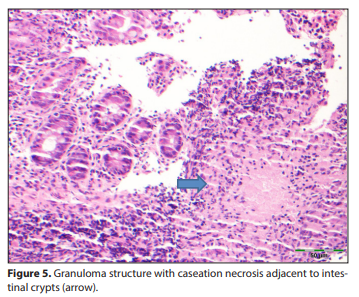
Three of the patients were female and two were male. Mean age was 12 ± 3 years. Median duration of complaints was 57 days (range: 15 and 90 days). No history of tuberculosis contact was detected in any case. The most common complaint was abdominal distension. Ascites was the most common finding on physical examination. Tuberculin skin test and interferon gamma release test were positive in only one case. The average adenosine deaminase level in the ascitic fluid was 65 UI/ dL. In this case, tuberculasis bacilli were isolated in ascitic fluid and sputum culture. The serum/ascites albumin gradient was below 1.1 g/dL in all cases. There was ascites on abdominal ultrasonography, and peritoneal thickening with ascites on abdominal computed tomography in all patients. Laparoscopic examination revealed peritoneal thickening and tuberous structures. Peritoneal biopsies revealed caseating chronic granulomatous inflammatory lesions consistent with a diagnosis of peritoneal tuberculosis. Median time to diagnosis was 14 days.
Conclusion
Tuberculasis peritonitis should also be considered in the differential diagnosis in patients with ascites. Early diagnosis and treatment are possible thanks to laparoscopic biopsy together with laboratory and radiological examinations. Mortality and morbidity related to the disease can be prevented in this way.

KEYWORDS

Tuberculasis peritonitis, child, laparoscopy, treatment

INTRODUCTION

Tuberculosis (TB) is an infectious disease as old as humanity (1). TB continues to be one of the most important causes of death from infectious diseases. The World Health Organization (WHO) reported that approximately 10 million people were diagnosed with TB in 2021, and 11% of these cases were children (2). Approximately 1 to 2 million people die from TB annually. TB primarily affects the lungs, with 16% being extrapulmonary TB (3). Abdominal TB is seen in 6-38% of untreated pulmonary TB cases and can frequently involve the gastrointestinal system, peritoneum and mesenteric lymph nodes (4,5). Abdominal TB most commonly affects the ileocecal region, but peritoneal involvement is also seen in 50- 83% of patients (6,7). TB peritonitis is rare in children. Almost all patients with TB peritonitis have clinical or subclinical ascites that develop slowly and progressively, and the most common complaint at presentation is abdominal distension (6). The most common finding on physical examination is ascites. Ascites has been reported in 93% of cases, even in all with peritoneal TB (8). In this study, five pediatric cases who presented with abdominal distension and were diagnosed with TB peritonitis by laparoscopic biopsy are presented.

MATERIALS AND METHODS

This study was planned as a retrospective cohort study. The aim of this study was to examine and discuss the clinical and laboratory findings of children admitted to the pediatric gastroenterology, hepatology and nutrition clinic of a university hospital with the diagnosis of TB peritonitis between 2005 and 2024. The files of the cases were examined in detail, and the clinical and laboratory data obtained as a result of these examinations were recorded in the study forms. Tuberculin skin test (TST) was evaluated 48-72 hours after intradermal injection of five units of tuberculin purified protein derivative. Induration of ≥15 mm was considered positive in previously vaccinated patients and ≥10 mm in unvaccinated patients (9). Clinical and laboratory findings of pediatric cases diagnosed with TB peritonitis were evaluated, clinical features, treatments and outcomes were examined and discussed with the literature. Statistical Analysis Clinical and laboratory data obtained from the patients were first recorded in the forms given in the appendix. Descriptive statistical methods such as mean ± standard deviation, minimum maximum frequency and percentage were used in the statistical analysis of the study.

RESULTS

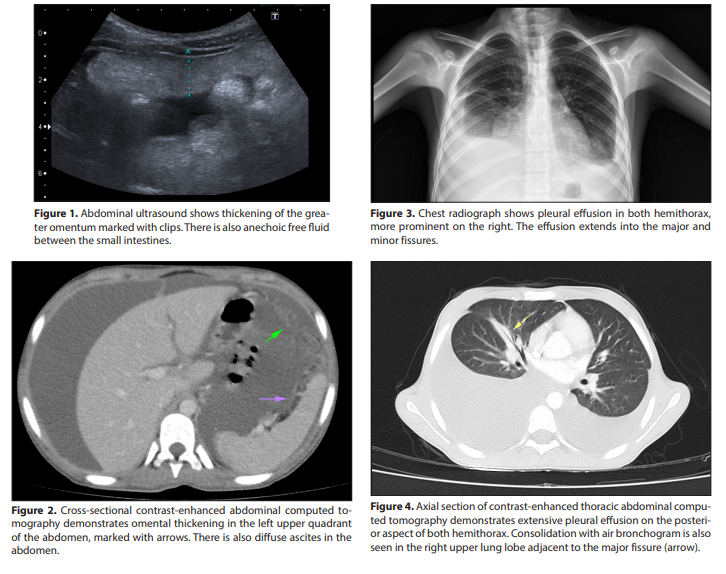
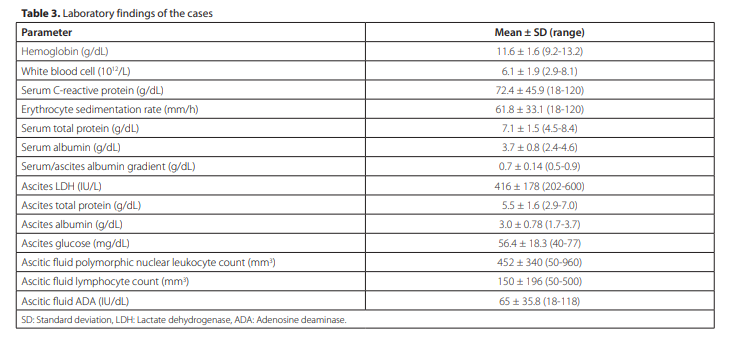
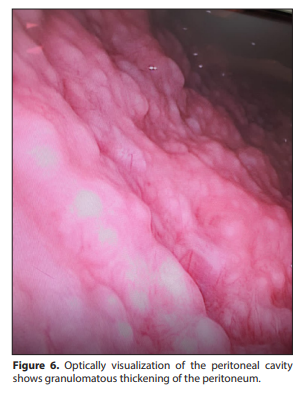
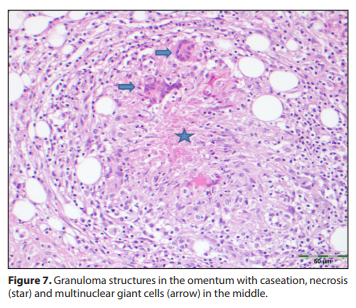
Five cases diagnosed with TB peritonitis were examined. Three of the cases were female and two were male, and median age was 12 years (range: 7.5 to 16 years). All cases presented with complaints of abdominal distension. In addition, three cases had complaints of abdominal pain and weight loss. One case had respiratory distress. Two of the cases had cough, night sweats, and fever. Median duration of symptoms was 57 days (range: 15 to 90 days). Median time to diagnosis was 14 days (range: 12 to 15 days). None of the cases had a history of contact with TB. Demographic data and clinical findings of the cases are summarized in Table 1. All cases had TST, but only two of the patients had a Bacillus Calmette-Guérin vaccination scar at the time of presentation. Induration >15 mm was observed in only one case; this case was using adalimumab (third generation tumor necrosis factor inhibitor) for uveitis due to juvenile rheumatoid arthritis. Abdominal ultrasonography revealed diffuse ascites in the abdomen in all cases (Figure 1). Abdominal computed tomography revealed heterogeneity, thickening and diffuse ascites in the omentum in all cases (Figure 2). Bilateral extensive pleural effusion due to lung involvement was detected in one case (Figure 3). Thoracic computed tomography of the patient revealed extensive pleural effusion in both hemithorax and air bronchogram adjacent to the major fissure in the upper lobe of the right lung (Figure 4). Bilateral chest tube was inserted to drain the pleural effusion in this case. Radiological findings of the cases are presented in Table 2. Paracentesis was performed in all cases. In all cases, ascitic fluid was observed to be yellow and cloudy (exudate). Serumascitic albumin gradient (SAAG) was detected as <1.1 gr/dL. Complete blood count, blood biochemistry and ascitic fluid laboratory findings of the cases are shown in Table 3. Median adenosine deaminase (ADA) level of ascitic fluids was 65 U/L (range: 18 to 118 U/L). Microscopic examination of ascitic fluids revealed abundant lymphocytes in three cases and abundant polymorphnuclear leukocytes in two cases. TB bacilli grew in the ascitic fluid and sputum cultures of one case. In this case, sparsely located bacilli in acid-fast bacilli (AFB) stain were seen in the peritoneal biopsy. TB bacilli polymerase chain reaction (PCR) was negative in ascitic fluid in all cases. A patient receiving adalimumab for uveitis due to juvenile rheumatoid arthritis had abdominal pain and diarrhea. This patient underwent colonoscopy after bowel preparation. Colonoscopy showed an edematous and hyperemic ileocecal valve. The terminal ileum could not be entered because of the risk of perforation. Histopathological examination of colon biopsies showed necrotizing granulomatous inflammation (intestinal TB) (Figure 5). Colonoscopy performed on this patient after treatment for TB showed complete resolution of the old lesions. All patients underwent diagnostic laparoscopy. During laparoscopic examination, it was observed that there was free fluid in the abdomen and the peritoneum was thick and fragile. Visualization with optically inserted trocar revealed adhesions and granulomatous thickening between the intestinal rings and the peritoneum in the abdomen that did not allow imaging (Figure 6). Histopathological examination of peritoneal biopsies revealed non-necrotizing granulomatous peritonitis (Figure 7). All cases received quadruple anti-TB treatment for 12 months. Urticarial reactions were observed in two cases due to isoniazid. In these two cases, isoniazid was stopped for a certain period and then restarted. One case with lung involvement was given corticosteroid treatment for four weeks. The cases were observed to recover completely with treatment. No problems were observed in the one-year follow-up after completion of treatment.
DISCUSSION

In the 2020 Türkiye Tuberculosis Control Report, it was reported that the total number of TB cases in our country was 11.786 and the incidence of TB was 14.1 per hundred thousand (10). TB peritonitis is reported in approximately 3.5% of patients with pulmonary TB and 31-58% of patients with abdominal TB. TB peritonitis can be seen in 1% of all patients with TB (5). Gürkan et al. published 11 cases of children with TB peritonitis in 1999 (11). After that, Dinler et al. reported nine cases of children with TB peritonitis from our country in 2009 (12). In the following years, pediatric cases diagnosed with TB peritonitis in our country were presented as case reports (13-17). These studies support the fact that TB peritonitis in children is rare in our country, as in the world. Peritoneal TB is usually seen in children with immune deficiency (8). In the present study, one patient was using adalimumab due to juvenile rheumatoid arthritis. Studies have reported that the ages of children followed up for TB peritonitis ranged from 9 to 14 years (11-14). Mean age of the cases in the present study was 12, which is consistent with this article. Patients with TB peritonitis most commonly present with complaints of abdominal distension, abdominal pain, and weight loss (12). In the present study, all children had abdominal distension and three had abdominal pain and weight loss. The data in the present study were consistent with the literature (8,12,17). A history of contact with a TB case was reported in 66.6% of the cases with TB peritonitis (12). However, none of our cases had a history of contact. Among all cases in which TST was performed, only one case was found to have an induration >15 mm. It was thought that the negative TST determination in the other four cases might have been due to differences in the applied technique, solution used and interpretation (18). In laboratory tests, no disease-specific findings were observed in complete blood count. White blood cell count is usually within normal range. In the present study, white blood cell count was found to be normal. Data in the present study were consistent with the literature (12). Erythrocyte sedimentation rate is usually increased (19). It was found to be significantly elevated in three of our cases. Pulmonary involvement is reported in 12-55% of cases with TB peritonitis (12,15). In the present study, pulmonary involvement (pleural effusion) was observed in only one case, consistent with the literature. The bilateral chest tube inserted in this case was removed after the pleural effusion regressed with treatment. Radiological imaging techniques such as abdominal ultrasonography and computed tomography provide very useful information in the diagnosis of TB peritonitis. The most common finding on abdominal ultrasonography is free fluid accumulation in the abdomen (20). All patients in the present study had ascites in their abdomen on abdominal ultrasonography. Abdominal computed tomography shows free fluid, omental thickening, and enlarged lymph nodes in the abdomen due to TB peritonitis (20-22). In this study, radiological findings were consistent with the literature. Paracentesis was performed in all cases. The ascitic fluid was found to be exudative, rich in lymphocytes, and SAAG was below 1.1 g/dL. The data obtained in present study were consistent with the literature (23). It is thought that these findings may be reliable parameters in the diagnosis of TB peritonitis. The most reliable method for the diagnosis of TB is the culture of TB bacillus (Mycobacterium tuberculosis) from body fluids. On direct microscopic examination of ascitic fluid, AFB can be seen in less than 2% of cases (24). It is reported that TB bacillus growth in culture is between 0-83% (25). In our study, AFB was detected in the ascitic fluid of one case and M. tuberculosis grew in the ascitic fluid of the same case. In noncirrhotic cases, measurement of ADA in ascitic fluid remains a highly reliable laboratory test for the diagnosis of TB peritonitis (26). In the present study, ADA levels were found to be elevated in 80% of cases, consistent with the literature. In cases of TB peritonitis, low AFB positivity in ascitic fluid leads to a decrease in the sensitivity of the PCR test (27). In the present study, AFB PCR positivity was not detected in any case of ascitic fluid. Laparoscopic examination is the most commonly used method for peritoneal imaging and peritoneal biopsy (28). It continues to be the most appropriate method for early and definitive diagnosis of the disease (12). The most common findings in laparoscopic examination are ascites, peritoneal thickening, adhesions, and millimetric tuberous structures (27). In the present study, laparoscopic examination findings of our cases were consistent with the literature. Pathological examination of chronic granulomatous inflammatory reaction with caseation is highly specific for TB peritonitis (29). Similar findings were observed in the pathological examination of peritoneal biopsy in our cases. It has been reported that corticosteroid treatment reduces complications and mortality in cases of TB peritonitis (26). In the present study, it was observed that four weeks of corticosteroid treatment accelerated recovery in a case with bilateral pleural effusion. TB continues to be an important health problem worldwide, especially in underdeveloped and developing countries. Although TB peritonitis is not common in children, it is a disease that should be considered in the differential diagnosis of children presenting with abdominal distension due to ascites. Mortality and morbidity can be prevented through early diagnosis and treatment with laparoscopic examination in addition to history, physical examination and laboratory tests.

REFERENCES

1
Bayat AH. Tıp Tarihi. İstanbul: Merkezefendi Geleneksel Tıp Derneği, 2016
2
Halk Sağlığı Genel Müdürlüğü. Türkiye’de Verem Savaş 2020 Raporu. Erişim adresi: https://hsgm.saglik.gov.tr/depo/birimler/tuberkuloz-db/ Dokumanlar/Raporlar/Turkiyede_Verem_Savasi_2020_Raporu.pdf
3
Gürkan F, Ozateş M, Boşnak M, Dikici B, Boşnak V, Taş MA, et al. Tuberculous peritonitis in 11 children: clinical features and diagnostic approach. Pediatr Int 1999;41:510-3. https://doi.org/10.1046/j.1442- 200x.1999.01114.x
4
Dinler G, Sensoy G, Helek D, Kalayci AG. Tuberculous peritonitis in children: report of nine patients and review of the literature. World J Gastroenterol 2008;14:7235-9. https://doi.org/10.3748/wjg.14.7235
5
Özmen Z, Aktaş F, Aktaş T, Şenel U, Tanrıverdi Hİ, Aslan K, et al. Radiological findings in a child with tuberculosis peritonitis. Yeditepe Medical Journal 2015;9:888-94. https://doi.org/10.15659/yeditepemj.15.10.119
6
Urgancı N, Gümüştekin R, Seçinti İP. Atipik prezentasyonlu tüberküloz peritoniti: Olgu sunumu. Fırat Tıp Dergisi 2020;25:101-4.
7
Maamatou W, Jabloun A, Daib A, Jarray L, Ben Abdallah R, Hellal Y, et al. Place of laparoscopy in peritoneal tuberculosis. J Laparoendosc Adv Surg Tech 2021;31:1480-4. https://doi.org/10.1089/lap.2021.0374
8
Sezer BT, Çelik Y, Çalışkan Y, Türkel T, Balkan ME, Kılıç N. An Important diagnosis of ascites and abdominal mass coexistence in a child: Peritoneal tuberculosis. Turkish J Ped Surg 2023;10:115-8. https://doi. org/10.62114/JTAPS.2023.63702
9
Kara M, Odacılar A.C, Hançerli Törün S, Sütçü M, Erginel B, Çalışkan E, et al. A case of tuberculosis peritonitis diagnosed by way of laparoscopy. J Child 2017;17:84-8.
10
Dinler G, Şensoy G. Çocukluk çağında tüberküloz peritonit. Çocuk Enf Derg 2009;3:182-6
11
Manohar A, Simjee AE, Haffejee AA, Pettengell KE. Symptoms and investigative findings in 145 patients with tuberculous peritonitis diagnosed by peritoneoscopy and biopsy over a five year period. Gut 1990;31:1130-2. https://doi.org/10.1136/gut.31.10.1130
12
World Health Organization. Global tuberculosis report 2021. January 15, 2022. Available from: https://www.who.int/publications/i/ item/9789240037021
13
Zaslavsky J, Mulugeta-Gordon L, Vasko I, Presenza T, Scattergood E, Meislich D, et al. Tuberculous peritonitis in children: Two case reports highlighting the important role of imaging. Radiol Case Rep 2018;13:862-6. https://doi.org/10.1016/j.radcr.2018.05.010
14
Avcu G, Sensoy G, Karli A, Caltepe G, Sullu Y, Belet N, et al. A case of tuberculous peritonitis in childhood. J Infect Public Health 2015;8:369-72. https://doi.org/10.1016/j.jiph.2015.03.004
15
Guirat A, Koubaa M, Mzali R, Abid B, Ellouz S, Affes N, et al. Peritoneal tuberculosis. Clin Res Hepatol Gastroenterol 2011;35:60-9. https://doi. org/10.1016/j.gcb.2010.07.023
16
Rasheed S, Zinicola R, Watson D, Bajwa A, McDonald PJ. Intra-abdominal and gastrointestinal tuberculosis. Colorectal Dis 2007;9:773-83. https://doi.org/10.1111/j.1463-1318.2007.01337.x
17
Debi U, Ravisankar V, Prasad KK, Sinha SK, Sharma AK. Abdominal tuberculosis of the gastrointestinal tract: revisited. World J Gastroenterol 2014;20:14831-40. https://doi.org/10.3748/wjg.v20.i40.14831
18
Singh MM, Bhargava AN, Jain KP. Tuberculous peritonitis. An evaluation of pathogenetic mechanisms, diagnostic procedures and therapeutic measures. N Engl J Med 1969; 281:1091-4. https://doi.org/10.1056/ NEJM196911132812003
19
Lewinsohn DM, Leonard MK, LoBue PA, Cohn DL, Daley CL, Desmond E, et al. Official American Thoracic Society/Infectious Diseases Society of America/Centers for Disease Control and Prevention Clinical Practice Guidelines: Diagnosis of tuberculosis in adults and children. Clin Infect Dis 2017;64:111-5. https://doi.org/10.1093/cid/ciw778
20
Uzunkoy A, Harma M, Harma M. Diagnosis of abdominal tuberculosis: experience from 11 cases and review of the literature. World J Gastroenterol 2004;10:3647-9. https://doi.org/10.3748/wjg.v10.i24.3647
21
Chahed J, Mekki M, Mansour A, Ben Brahim M, Maazoun K, Hidouri S, et al. Contribution of laparoscopy in the abdominal tuberculosis diagnosis: retrospective study of about 11 cases. Pediatr Surg Int 2010;26:413- 8. https://doi.org/10.1007/s00383-010-2555-z
22
Bolognesi M, Bolognesi D. Complicated and delayed diagnosis of tuberculous peritonitis. Am J Case Rep 2013;14:109-12. https://doi. org/10.12659/AJCR.883886
23
World Health Organization. Global tuberculosis report 2020. Erişim adresi: https://www.who.int/publications/i/item/9789240013131 (Erişim tarihi: Mayıs 2022)
24
Cruz AT, Starke JR. Clinical manifestations of tuberculosis in children. Paediatr Respir Rev 2007;8:107-17. https://doi.org/10.1016/j. prrv.2007.04.008
25
Sanai FM, Bzeizi KI. Systematic review: tuberculous peritonitis--presenting features, diagnostic strategies and treatment. Aliment Pharmacol Ther 2005;22:685-700. https://doi.org/10.1111/j.1365- 2036.2005.02645.x
26
Wells AD, Northover JM, Howard ER. Abdominal tuberculosis: still a problem today. J R Soc Med 1986;79:149-53. https://doi. org/10.1177/014107688607900307
27
Jakubowski A, Elwood RK, Enarson DA. Clinical features of abdominal tuberculosis. J Infect Dis 1988;158:687-92. https://doi.org/10.1093/infdis/158.4.687
28
Chow KM, Chow VC, Hung LC, Wong SM, Szeto CC. Tuberculous peritonitis-associated mortality is high among patients waiting for the results of mycobacterial cultures of ascitic fluid samples. Clin Infect Dis 2002;35:409-13. https://doi.org/10.1086/341898
29
Yaşar Durmuş S, Tanır G, Ekşioğlu AS, Aydın Teke T, Taşçı Yıldız Y, Kaman A, et al. Abdominal tüberküloz tanılı çocuk hastaların retrospektif olarak değerlendirilmesi: tek merkez deneyimi. Çocuk Enf Derg 2020;4:224-30. https://doi.org/10.5578/ced.69283