
 Türkçe
 English


ABSTRACT
A six-year-old boy, was brought in with fever and a skin rash. It was learned that his fever started suddenly, accompanied by a rash that had begun on the front of his trunk and rapidly spread throughout his body about three days prior. Physical examination revealed hyperemic, hypertrophic, and cryptic tonsils. Pallor around the mouth, red strawberry tongue, Pastia lines, a widespread erythematous rash that blanched on pressure, and a sandpaper-like appearance of the skin were observed. Laboratory investigations showed a white blood cell count of 25.890/mm³, a neutrophil count of 24.640/mm³, and a C-reactive protein of 287 mg/L. The rapid streptococcal antigen test was positive, and the patient was admitted to the pediatric infectious diseases service with a diagnosis of scarlet fever. Treatment with ceftriaxone, which was started upon initial admission, was continued. Streptococcus pyogenes was isolated from the throat swab, but no growth was observed in the blood culture. Due to the persistence of high fever and clinical weakness during follow-up, clindamycin was added to the treatment. After treatment, the high fever was controlled and the patient’s general condition improved significantly. Following the regression of the rash, significant desquamation developed throughout the trunk. With appropriate antibiotic treatment, the patient’s clinical findings completely resolved, and they were discharged without complications.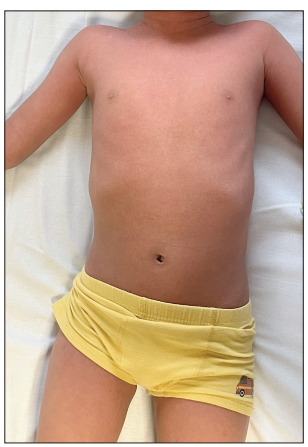
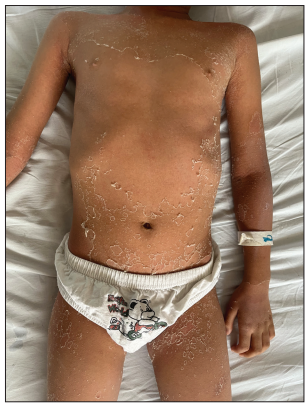
Scarlet fever is a disease caused by streptococcal pyro - genic exotoxins produced by S. pyogenes, characterized by fever, pharyngitis, a characteristic rash, and mucosal find - ings. Typically, an erythematous rash that starts on the trunk and spreads, which blanches on pressure, is observed, along with a strawberry tongue appearance and perioral pallor. Desquamation of the skin that develops during the conva - lescent period is an important clinical finding supporting the diagnosis. This desquamation usually begins within a week of the onset of the disease. In the differential diagnosis of scarlet fever, other diseases that cause skin desquamation, such as Kawasaki disease, measles, and staphylococcal toxic shock syndrome, should also be considered. Complications can be largely prevented with early diagnosis and appropri - ate antibiotic treatment.